
The Alliance for Clinical and Translational Research • Supported by NIGMS/NIH | Award No. P50GM133807
JULY 2026 | Health & Safety Newsletter
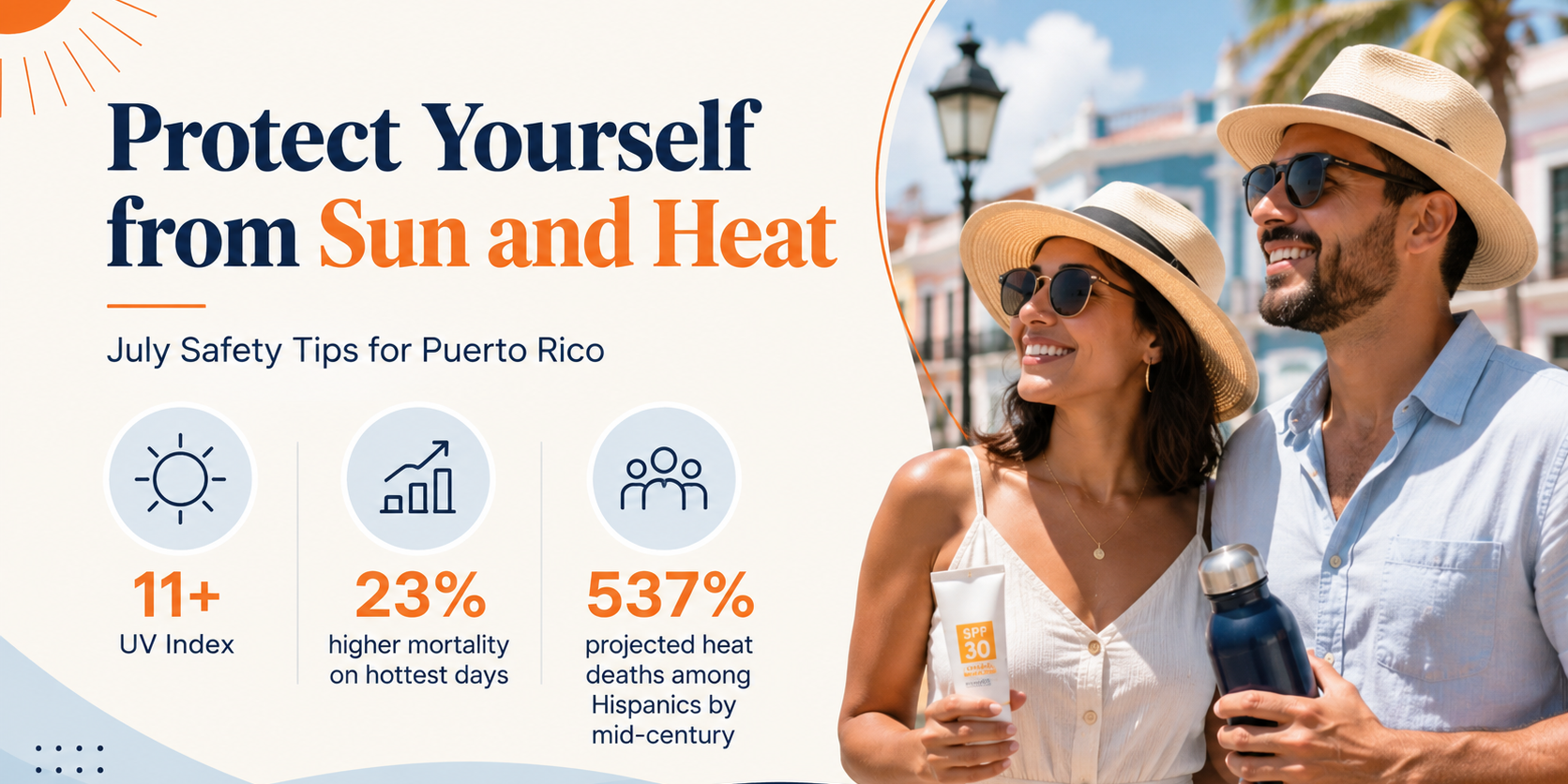
Protect Yourself from Sun and Heat This July
Evidence-Based Guidance for Puerto Rico
July is one of the most intense months of the year in Puerto Rico. The sun hits hard from early morning, and the heat lingers well into the night. This newsletter gives you practical, science-backed guidance from studies conducted right here in Puerto Rico and among Hispanic communities, so you and your family can stay safe.
Sources: Nazario 2021, Méndez-Lázaro 2025, Diaz-Collado 2025, Khatana 2024
☀ SECTION 1: SUN SAFETY IN PUERTO RICO
Why the Sun Feels Different in Puerto Rico
Puerto Rico receives ultraviolet (UV) radiation year-round without any seasonal break, unlike most of the United States (U.S.). In July, the UV Index regularly reaches 11 or higher, the Extreme category defined by the EPA (2026) and WHO (2022). At that level, unprotected skin can burn in less than 10 minutes. (Nazario et al., 2021)
Even so, a study conducted in Ponce, Puerto Rico found that fewer than half of Hispanic participants consistently protected themselves from the sun, and nearly 30% had experienced a sunburn in the past year, even among those who were aware of the risks. (Lacson et al., 2023)
Melanoma rates among Hispanics have increased by 20% over the past two decades. Puerto Rico also exhibits cancer patterns that differ from those of Hispanics on the U.S., underscoring the need for prevention strategies tailored to the island’s unique population and environmental conditions. (Miller et al., 2021)
Important — A Common Misconception:
Many people believe that brown or tan skin protects against sun damage. The science shows it does not. Hispanic skin shares the same vulnerability to UV-induced DNA damage as lighter skin tones. Research finds that machismo, low perceived priority, and limited access are the main barriers to sun protection among Hispanics, while familismo, caring for your family, is one of the strongest motivators for change. (Niu et al., 2024)
UVA Rays
Penetrate deep into the skin, causing premature aging and contributes to the development of skin cancer. Thet are present throughout the day, even on cloudy days, and can pass through car windows. You cannot feel their effects, but the damage occurs just the same.
Protection: broad-spectrum SPF 30+ sunscreen.
UVB Rays
Responsible for sunburns and are the primary cause of most skin cancers. Strongest between 10 a.m. and 4 p.m.. In Puerto Rico, unprotected skin can burn in as little as 10 minutes during the summer months.
Protection: shade, protective clothing, a wide-brimmed hat.
Sun Protection Recommendations
- Apply broad-spectrum SPF 30 or higher at least 15 minutes before going outside, even on cloudy days
- Reapply every 2 hours, and right away after swimming or sweating
- Wear UV-protective clothing (UPF 50+), a wide-brimmed hat, and UV-blocking sunglasses — especially for outdoor workers
- Find shade between 10 a.m. and 4 p.m., when UV levels are at their peak
- Avoid tanning beds. They emit concentrated UV radiation and significantly raise your risk of melanoma
- If you are going through chemotherapy or radiation, your skin may be more sensitive. Talk to your oncologist before spending time outdoors
- Protecting your family from skin cancer is an act of love and familismo (Niu et al., 2024)
What the Research Tells Us About Skin Cancer in Our Community
Hispanic outdoor workers in agriculture, construction, and tourism face the highest cumulative UV exposure and an elevated risk of keratinocyte carcinoma. This is a reality that hits especially close to home in Puerto Rico. (Kolitz et al., 2022)
Cancer data confirm that Puerto Rico has its own patterns, different from those of Hispanics on the mainland. Prevention campaigns need to be built around our community, not borrowed from somewhere else. (Miller et al., 2021)
🌡 SECTION 2: EXTREME HEAT — THE PUERTO RICO REALITY
Heat Is Already Killing People in Puerto Rico
A study of San Juan and Bayamon between 2009 and 2013 found that on the hottest summer days, stroke deaths increased 16-fold (RR = 16.80) and cardiovascular deaths increased 16-fold (RR = 16.63). These are not projections. They are real death records from our metropolitan area. (Méndez-Lázaro et al., 2018)
A follow-up study of Puerto Rico from 2015 to 2020 found that days with the highest heat index were linked to a 23% increase in overall mortality (IRR: 1.23). The leading causes were heart attack, ischemic heart disease, heart failure, and cerebrovascular disease. (Méndez-Lázaro et al., 2025)
A municipality-level study of Puerto Rico from 2015 to 2023 found that extreme temperatures account for 3.88% of all deaths on the island. Extreme heat alone was linked to a 16% increase in mortality risk. The study also mapped which municipalities are most at risk. (Diaz-Collado et al., 2025)
NWS San Juan:
During the summer, extreme heat conditions in Puerto Rico have led the National Weather Service in San Juan to warn the population about the dangers posed by the combination of high temperatures and humidity, particularly for the most vulnerable groups without access to adequate cooling or hydration (NWS San Juan)
Who Is Most at Risk in Our Community?
Higher Biological Risk
- Adults 65 and older. The body loses its ability to sweat and regulate temperature with age. Studies in Puerto Rico show this group tends to underestimate their own risk (Guzman-Colon et al., 2025)
- People with high blood pressure, diabetes, or heart disease — conditions very common in Puerto Rico
- Cancer patients in active treatment. Some medications affect the body’s ability to handle heat
- Pregnant women. Heat increases the risk of preterm birth and low birth weight
Higher Structural Risk
- Low-income families without reliable air conditioning (Guzman-Colon et al., 2025)
- Municipalities with lower socioeconomic development. Post-Maria data showed a 43% higher mortality ratio in the island’s poorest communities (Santos-Burgoa et al., 2018)
- Outdoor workers in agriculture, construction, and tourism are exposed to sun and heat every single day
- Communities with fragile electrical infrastructure. Prolonged power loss after Maria directly caused heat-related deaths (Kishore et al., 2018)
Recognize a Heat Emergency — Act Quickly
- Heat Cramps: muscle pain during or after physical activity. Move to a cool place, drink water with electrolytes, and rest
- Heat Exhaustion: heavy sweating, weakness, pale and clammy skin, rapid pulse, nausea. Get medical attention right away and cool the person down immediately
- Heat Stroke (EMERGENCY): body temperature above 103°F (39.4°C), hot red skin, rapid strong pulse, confusion or loss of consciousness. Call 9-1-1 immediately. This can be fatal
- After Hurricane Maria, an estimated 4,645 excess deaths occurred, with one third attributed to delayed or interrupted healthcare linked to power loss. Be especially vigilant during power outages (Kishore et al., 2018)
Extreme Heat Action Plan for Puerto Rico
- Drink water every 15 to 20 minutes during outdoor activity. Do not wait until you are thirsty — thirst is already a sign of early dehydration.
- Stay in air-conditioned spaces between 10 AM and 4 PM. If you do not have AC at home, go to a cooling center — a library, community center, or mall.
- Never leave children, elderly people, or pets in a parked vehicle. Interior temperature rises 20°F in just 10 minutes.
- Check out elderly neighbors who live alone. In Puerto Rico, even July nights can be dangerously hot (Diaz-Collado et al., 2025)
- Follow NWS San Juan alerts at weather.gov/sju. They issue warnings when the heat reaches dangerous levels.
- During extended power outages, contact your municipality to find the nearest cooling center. (Kishore et al., 2018)
🏥 SECTION 3: FOR HEALTHCARE PROFESSIONALS
A systematic review confirms a clear link between extreme heat and cardiovascular mortality, with the highest risk in older adults, patients with pre-existing heart conditions, and low-income communities. Tropical climates like Puerto Rico represent a high-priority setting for clinical heat preparedness. (Singh et al., 2024)
Projections show that Hispanic adults will experience a 537% increase in extreme temperature-related deaths by mid-century, the largest projected increase of any racial or ethnic group in the United States. Taking clinical action now is a matter of health equity. (Khatana et al., 2024)
UV — Clinical Considerations
- Screen oncology patients for photosensitivity before advising sun exposure, especially during chemotherapy or radiation
- Educate patients that sunscreen is necessary even with darker skin tones — UV-induced DNA damage occurs regardless of skin color (Kolitz et al., 2022)
- Address cultural barriers. Machismo reduces sun protection compliance among Hispanic men. Tailor your message accordingly (Niu et al., 2024)
- Document family history of skin cancer alongside GI cancer history — relevant for Lynch Syndrome and other genetic predispositions
- Refer high outdoor-exposure patients to dermatology
- Remind patients that cloudy days in Puerto Rico still carry significant UVA exposure
Heat — Clinical Considerations
- Review medications for heat sensitivity at summer visits: diuretics, beta-blockers, ACE inhibitors, anticholinergics, antipsychotics
- Counsel patients with hypertension, diabetes, and cardiovascular disease on heat risks and hydration throughout July (Méndez-Lázaro et al., 2018)
- Post-Maria data showed widespread exacerbation of chronic conditions from infrastructure disruption. Monitor vulnerable patients closely during power outages (Kishore et al., 2018)
- During visits, ask: Does the patient have AC at home? Do they have a plan for power outages? Does someone check on them regularly? (Guzman-Colon et al., 2025)
- Provide documentation to employers when a patient needs protected work conditions during extreme heat warnings
📚 REFERENCES
- Díaz-Collado, F., et al. (2025). Mortality risk and burden associated with non-optimum temperatures in Puerto Rico. Environmental Research Letters, 20(10), 104032. doi:10.1088/1748-9326/ae013e
- Guzman-Colon, B., et al. (2025). Heat Risk Perception and Vulnerability in Puerto Rico: Insights for Climate Adaptation in the Caribbean. International Journal of Environmental Research and Public Health, 22(8), 1197. doi:10.3390/ijerph22081197
- Khatana, S. A. M., et al. (2024). Projections of Extreme Temperature-Related Deaths in the US. JAMA Network Open, 7(9), e2434942. doi:10.1001/jamanetworkopen.2024.34942
- Kishore, N., et al. (2018). Mortality in Puerto Rico after Hurricane Maria. The New England Journal of Medicine, 379(2), 162–170. doi:10.1056/NEJMsa1803972
- Kolitz, E., et al. (2022). UV Exposure and the Risk of Keratinocyte Carcinoma in Skin of Color: A Systematic Review. JAMA Dermatology, 158(5), 542–546. doi:10.1001/jamadermatol.2022.0263
- Lacson, J., et al. (2023). Skin cancer prevention behaviors, beliefs, distress, and worry among Hispanics in Florida and Puerto Rico. BMC Public Health, 23(1), 2234. https://doi.org/10.1186/s12889-023-17039-y
- Méndez-Lázaro, P. A., et al. (2018). Climate change, heat, and mortality in the tropical urban area of San Juan, Puerto Rico. International Journal of Biometeorology, 62(5), 699–707. doi:10.1007/s00484-016-1291-z
- Méndez-Lázaro, P. A., et al. (2025). Too hot and too humid in the Caribbean: Impacts of extreme heat events and non-accidental mortality in the tropical island of Puerto Rico (2015–2020). The Journal of Climate Change and Health, 25, 100484. doi:10.1016/j.joclim.2025.100484
- Miller, K. D., et al. (2021). Cancer statistics for the US Hispanic/Latino population, 2021. CA: A Cancer Journal for Clinicians, 71(6), 466–487. doi:10.3322/caac.21695
- National Weather Service. (n.d.). Experimental graphical hazardous weather outlook: San Juan, PR. National Oceanic and Atmospheric Administration. Retrieved June 23, 2026, from https://www.weather.gov/erh/ghwo?wfo=sju
- Nazario, C. M., et al. (2022). Sun Exposure Is Associated with Reduced Breast Cancer Risk among Women Living in the Caribbean: The Atabey Study in Puerto Rico. Cancer Epidemiology, Biomarkers & Prevention, 31(2), 430–435. doi:10.1158/1055-9965.EPI-21-0932
- Niu, Z., Rivera, Y. M., Baskar, J., Shanmugavel, A., Manne, S. L., Hudson, S. V., Penedo, F. J., & Heckman, C. J. (2024). Barriers and facilitators to skin cancer prevention among Hispanics: a qualitative study. BMC Public Health, 24(1), 2690. https://doi.org/10.1186/s12889-024-20000-2
- Santos-Burgoa, C., et al. (2018). Differential and persistent risk of excess mortality from Hurricane Maria in Puerto Rico: a time-series analysis. The Lancet Planetary Health, 2(11), e478–e488. doi:10.1016/S2542-5196(18)30209-2
- Singh, N., et al. (2024). Heat and Cardiovascular Mortality: An Epidemiological Perspective. Circulation Research, 134(9), 1098–1112. doi:10.1161/CIRCRESAHA.123.323615
- U.S. Environmental Protection Agency (EPA). (2026, June 15). UV index scale. https://www.epa.gov/sunsafety/uv-index-scale-0
- World Health Organization (WHO). (2022, June 20). Radiation: The ultraviolet (UV) index. https://www.who.int/news-room/questions-and-answers/item/radiation-the-ultraviolet-(uv)-index
📞 EMERGENCY & HEALTH RESOURCES
Emergency Services
- Emergency: 9-1-1
- PR Health Department: 787-765-2929
- Poison Control: 1-800-222-1222
- UPR Cancer Center: (787) 772-8300
Heat & UV Resources
- NWS San Juan alerts: weather.gov/sju
- Ready.gov- https://www.ready.gov/heat
- EPA UV Safety: epa.gov/sunsafety
- NOAA UV Index: airnow.gov/uv-index